


Isotonic Energy Gel vs Regular Energy Gel: What's the Difference?
If you have ever compared energy gels, you have probably noticed that some are labelled isotonic while others are described as regular or conventional energy gels.
Both types are designed to provide carbohydrates during exercise. However, there is an important difference in how they are formulated and how you use them.
Regular energy gels contain concentrated carbohydrates in a relatively small amount of liquid. They are designed to provide fuel in a compact package and are generally taken with water.
Isotonic energy gels contain more water in their formulation. They are designed to have a concentration similar to the body's fluids, which means they can generally be consumed without needing an additional drink of water at the same time.
But does this mean isotonic gels are better? Are they easier on your stomach? And which type should you choose for your next marathon, cycling event or long training session?
Let's look at the differences, what the research tells us and how to choose the right option for your training.
What is the difference between an isotonic energy gel and a regular energy gel?
The main difference is the concentration of carbohydrates and water within the gel.
Regular energy gels are concentrated carbohydrate products. They provide a relatively large amount of carbohydrate in a small serving. Because of their high concentration, they are generally designed to be consumed with water.
Isotonic energy gels contain more water relative to their carbohydrate content. Their formulation is designed to have an osmotic concentration similar to body fluids.
This means they can generally be consumed without taking an additional mouthful of water at the same time.
Here is a simple comparison.
| Feature | Regular energy gel | Isotonic energy gel |
|---|---|---|
| Carbohydrate concentration | High | Lower relative concentration |
| Water content | Usually lower | Usually higher |
| Consumed with water | Generally recommended | Usually not required at the same time |
| Packaging | Often smaller sachets | Often larger sachets |
| Carbohydrate per serving | Varies by product | Varies by product |
| Main purpose | Compact carbohydrate delivery | Convenient carbohydrate delivery without additional water at that moment |
It is important to remember that not all energy gels contain the same amount of carbohydrate.
An isotonic gel is not automatically lower in total carbohydrates than every regular gel. You need to compare the nutritional information and serving size on the packaging.
What is an isotonic energy gel?
An isotonic energy gel is a sports nutrition product designed to provide carbohydrates in a solution with an osmotic concentration similar to that of body fluids.
To understand this, it helps to know what osmolality means.
Osmolality describes the concentration of dissolved particles in a liquid. These particles can include sugars and electrolytes.
When a product has a concentration similar to body fluids, it is described as isotonic.
This is important because the concentration of a carbohydrate product can influence how it moves through the digestive system.
Traditional energy gels are often highly concentrated. They contain a relatively large amount of carbohydrate compared with their liquid content.
Isotonic gels are formulated differently, with more water relative to the carbohydrate concentration.
Does isotonic mean faster absorption?
Not necessarily.
An isotonic formulation may influence how a product behaves in the stomach and digestive system. However, this does not automatically mean that the carbohydrates reach your muscles faster or provide better performance.
Carbohydrate absorption involves several processes, including digestion, transport through the intestinal wall and delivery into the bloodstream.
The type of carbohydrate, the amount consumed, exercise intensity and individual digestive tolerance can all influence these processes.
It is therefore important not to confuse the concentration of a gel with its overall absorption rate.
There is not enough direct comparative research to conclude that isotonic energy gels consistently deliver carbohydrates faster than conventional gels during running or cycling.
What is a regular energy gel?
A regular energy gel is a concentrated source of carbohydrates designed to provide fuel during exercise.
Most conventional sports gels contain approximately 20–30 g of carbohydrates per sachet, although this varies between products.
Common carbohydrate ingredients include:
- Maltodextrin
- Glucose
- Fructose
- Sucrose
Some gels use a combination of glucose and fructose.
These carbohydrates use different transport pathways in the intestine. Combining them can help athletes absorb and use larger amounts of carbohydrate during prolonged exercise.
Regular energy gels are popular because they are compact, portable and easy to carry during endurance events.
However, because they are concentrated, they are generally recommended with water.
Why should you take regular energy gels with water?
When you consume a concentrated energy gel, you introduce a relatively large amount of carbohydrate into your digestive system in a small volume.
Drinking water alongside the gel helps dilute the carbohydrate concentration in the stomach.
This can improve gastrointestinal tolerance for some athletes.
It also allows you to manage your carbohydrate intake and hydration separately.
The Australian Institute of Sport recommends consuming most conventional sports gels with water or another dilute fluid. This can help reduce the concentration of carbohydrates in the digestive system and may lower the risk of gastrointestinal discomfort.
However, drinking more water is not always better. Your fluid intake should reflect your individual needs, sweat losses and environmental conditions.
Isotonic energy gel vs regular energy gel: Which is easier on your stomach?
This is one of the most common reasons athletes consider switching to isotonic energy gels.
Some runners experience stomach discomfort when using conventional gels. Symptoms can include bloating, nausea and an uncomfortable feeling during exercise.
This can be particularly frustrating during long-distance running, when maintaining a consistent carbohydrate intake is important.
Because isotonic gels have a lower carbohydrate concentration relative to their water content, they may be a more convenient option for athletes who prefer not to take water with every gel.
However, this does not mean they are guaranteed to prevent stomach problems.
Gastrointestinal discomfort can have several causes:
- Consuming too much carbohydrate too quickly.
- Taking in more carbohydrate than you can comfortably tolerate.
- Poor fluid management.
- Exercising at a very high intensity.
- Individual sensitivity to certain carbohydrate ingredients.
- Using a product that you have not practised with during training.
The total amount of carbohydrate you consume is also important.
An isotonic gel may be easier for some athletes to use, but consuming too many gels can still cause digestive problems.
What does the research say?
Research published in the Journal of Strength and Conditioning Research in 2021 investigated how different energy gel intake schedules affected performance during prolonged cycling.
Ten trained cyclists completed three experimental trials.
They consumed one gel every 30 minutes, every 45 minutes or no gels during exercise. All participants also consumed a gel before starting.
The researchers found that consuming gels during the two-hour cycling session increased blood glucose levels and improved performance in the subsequent 15-minute time trial compared with consuming no gels during exercise.
This study provides useful evidence about carbohydrate intake during prolonged exercise.
However, it did not compare isotonic gels with regular gels. It also involved cycling rather than running.
The important takeaway is that carbohydrate intake during prolonged exercise matters. It does not establish that one type of gel is easier on the stomach than another.
There is still a need for more direct research comparing isotonic and conventional energy gels under the same exercise conditions.
Which energy gel provides more carbohydrates?
The answer depends on the individual product rather than whether it is isotonic or regular.
Conventional gels are often concentrated to provide a substantial amount of carbohydrate in a relatively small serving.
Isotonic gels contain more water, but their total carbohydrate content can vary considerably.
For example, a regular gel might contain 30 g of carbohydrate, while an isotonic gel might contain a different amount depending on its formulation and serving size.
This does not automatically make one product better.
The most important consideration is how much carbohydrate you need during exercise and how easily you can consume that amount.
How much carbohydrate do you need during exercise?
Carbohydrate requirements depend on exercise duration, intensity and individual tolerance.
The Australian Institute of Sport provides the following general guidance:
| Exercise duration | General carbohydrate guidance |
|---|---|
| Less than 45 minutes | Usually not required |
| 45–75 minutes | Small amounts may be useful |
| 1–2.5 hours | 30–60 g per hour |
| More than 2.5–3 hours | Up to 90 g per hour |
These are general sports nutrition guidelines rather than targets that every athlete must follow.
For longer events, some athletes gradually increase their carbohydrate intake towards 90 g per hour.
This requires practice, an appropriate carbohydrate combination and good gastrointestinal tolerance.
It is also important to remember that you do not need to get all your carbohydrates from energy gels.
Sports drinks, chews and other easily digested foods can contribute to your total intake.
Why carbohydrate content matters more than the type of gel
Imagine you are targeting 60 g of carbohydrate per hour.
You could achieve this through:
- Two gels containing 30 g of carbohydrate each.
- Three gels containing 20 g of carbohydrate each.
- A combination of gels and sports drink.
All three approaches could provide the same total carbohydrate intake.
The difference is how you deliver that carbohydrate and how comfortable you feel consuming it.
This is why checking the nutritional information is important.
Do not assume that all isotonic gels contain less carbohydrate or that every regular gel provides more energy.
When should you use an isotonic energy gel?
Isotonic energy gels can be a practical choice in situations where carrying or accessing water is difficult.
For example, they may be useful during:
Long-distance running
During a marathon, you may not want to rely on taking water every time you consume a gel. An isotonic product can provide a convenient alternative.
Trail running
On trails, water access may be limited between checkpoints. Having a gel that can be consumed without additional water at that moment may make your nutrition strategy easier.
Cycling
During long rides, athletes often have several products and bottles to manage. An isotonic gel can provide another way to consume carbohydrates without needing to drink immediately afterwards.
Training sessions
If you are testing different fuelling strategies, isotonic gels can be another option to assess for taste, convenience and digestive tolerance.
However, isotonic gels should not replace your overall hydration strategy.
Even if you do not need additional water immediately after consuming the gel, you still need to manage fluid intake throughout your session.
When should you use a regular energy gel?
Regular energy gels are a popular choice for athletes who want a concentrated and portable source of carbohydrates.
They can be particularly useful when you have access to water and want to reach a specific carbohydrate target.
For example, during a marathon, you may plan to consume a gel at regular intervals alongside water from aid stations.
They can also be useful during cycling events, where you can carry additional bottles and control your fluid intake.
Another advantage is that conventional gels are available in many different carbohydrate formulations.
Some contain glucose and fructose combinations, while others use maltodextrin or different carbohydrate blends.
This gives athletes more options when building a fuelling strategy.
Ultimately, a regular gel can work just as well as an isotonic gel when the carbohydrate intake, fluid strategy and individual tolerance are appropriate.
Is an isotonic energy gel better for marathon running?
Not necessarily.
Both isotonic and regular energy gels can be used during marathon running.
The best option depends on your carbohydrate requirements, access to water, product preferences and digestive tolerance.
For example, if you are running a marathon and targeting 60 g of carbohydrate per hour, you need to make sure your chosen products provide enough carbohydrates to meet that target.
If you choose a conventional gel, you will generally need to consume water alongside it.
If you choose an isotonic gel, you may not need additional water at the exact time you consume it.
However, you should still drink according to your hydration needs.
A 2025 observational study published in Sports Medicine - Open investigated the nutritional intake of 160 marathon runners competing in the Seville Marathon.
The researchers found that average carbohydrate intake during the race was approximately 35 g per hour.
Athletes who met the recommended carbohydrate intake of 60–90 g per hour were more likely to finish in under three hours.
However, this was an observational study. It cannot establish that higher carbohydrate intake directly caused faster finishing times.
It also did not compare isotonic and conventional energy gels.
The findings highlight the importance of planning carbohydrate intake during long-distance running rather than focusing only on the type of gel.
How to choose between an isotonic and regular energy gel
If you are unsure which type to use, consider the following factors.
1. Check the carbohydrate content
Start by looking at how many grams of carbohydrate each serving provides.
This will help you calculate how many gels you need to reach your hourly target.
2. Consider your water requirements
If you prefer to take a gel without drinking water at the same time, an isotonic product may be more convenient.
If you have regular access to water, conventional gels can be an equally practical option.
3. Consider your digestive tolerance
Everyone responds differently to sports nutrition products.
Some athletes prefer the consistency of isotonic gels, while others are comfortable with concentrated gels taken alongside water.
Test both options during training before using them in competition.
4. Look at the carbohydrate ingredients
The carbohydrate source can be just as important as the formulation.
If you are targeting higher carbohydrate intakes during prolonged exercise, look for products that provide suitable carbohydrate combinations, such as glucose and fructose.
5. Practise your fuelling strategy
Do not wait until race day to try a new product.
Use your training sessions to practise your planned carbohydrate intake, fluid strategy and gel timing.
This allows you to understand what works for you before an important event.
What about Q+ ISO and Q+ Gel?
At QUENCH, we offer two different energy gel options designed for endurance athletes.
Q+ ISO is a 60 ml pineapple-flavoured isotonic energy gel. It is caffeine-free and provides an option for athletes who prefer an isotonic gel formulation.
Q+ Gel is a concentrated carbohydrate energy gel available in orange mango flavour. Each gel provides 20 g of carbohydrates and is caffeine-free.
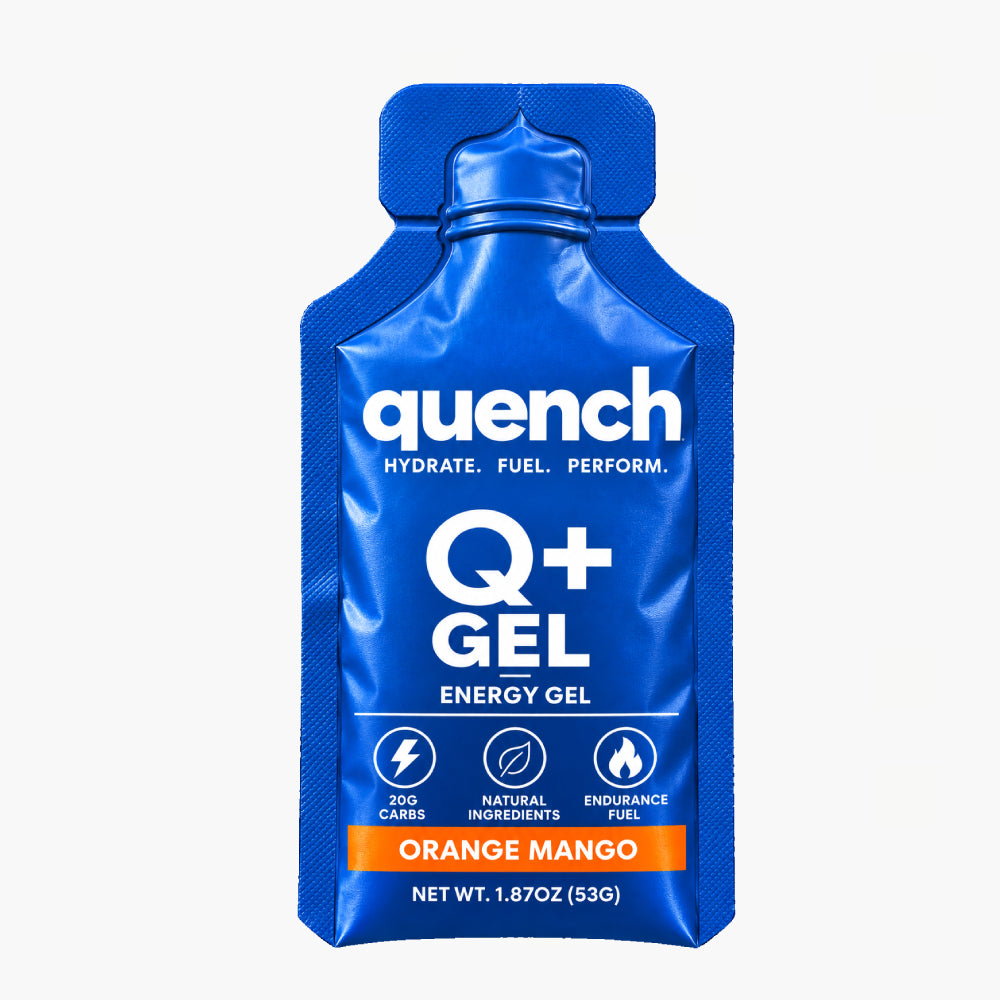
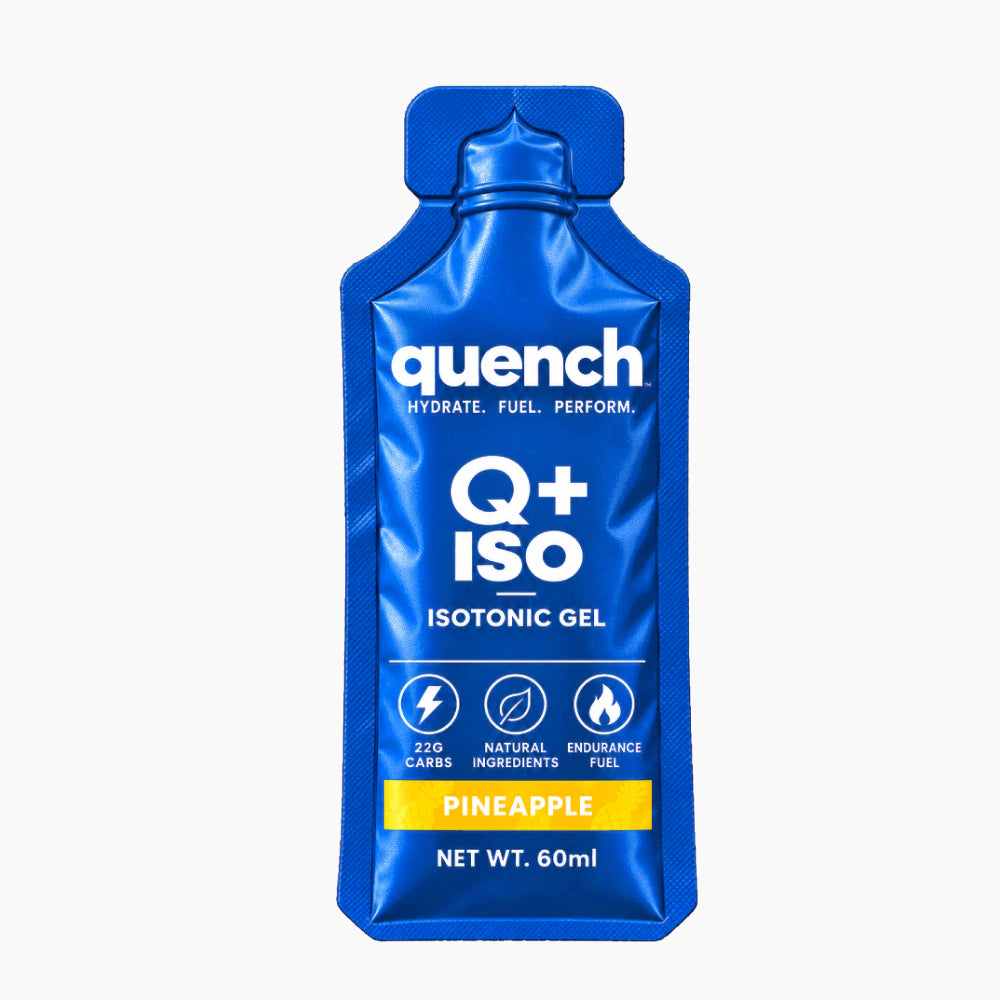
Both products can be considered when planning carbohydrate intake during running, cycling and triathlon training.
The main difference is their formulation and how you incorporate them into your fuelling strategy.
When comparing the products, consider the carbohydrate content, serving size, water instructions and your personal tolerance.
You should also account for carbohydrates from any sports drinks or other products you consume during exercise.
The goal is not simply to consume more gels. It is to find a practical strategy that provides the carbohydrates you need while keeping your stomach comfortable.
Final verdict: Isotonic energy gel vs regular energy gel
Both isotonic and regular energy gels have a place in endurance sports.
Regular energy gels provide concentrated carbohydrates in a compact serving. They are generally consumed with water and offer a convenient way to reach carbohydrate targets.
Isotonic energy gels contain more water relative to their carbohydrate concentration and are generally designed to be consumed without additional water at the same time.
Neither type is automatically better.
The right choice depends on your exercise duration, carbohydrate requirements, hydration strategy and individual digestive tolerance.
For marathon runners, cyclists and triathletes, the most important thing is to develop a fuelling strategy that you can maintain throughout your event.
Experiment with different products during training, check the carbohydrate content and practise your intake before race day.
The best energy gel is the one that helps you meet your fuelling requirements and that you can comfortably use throughout your event.
Frequently asked questions
1. What is the main difference between isotonic and regular energy gels?
The main difference is their carbohydrate concentration and water content. Regular gels are more concentrated and generally require water alongside them. Isotonic gels contain more water relative to their carbohydrate content and are designed to be consumed without additional water at the same time.
2. Do isotonic energy gels need water?
Generally, no. Specifically labelled isotonic gels are formulated to be consumed without additional water at the same time. However, you still need to maintain appropriate hydration during exercise.
3. Are isotonic energy gels easier to digest?
They may be more comfortable for some athletes because of their lower carbohydrate concentration relative to water content. However, there is insufficient direct evidence to conclude that isotonic gels consistently cause fewer stomach problems than regular gels.
4. Do regular energy gels provide more carbohydrates?
Not always. Regular gels are often more concentrated, but the total carbohydrate content depends on the serving size and formulation. Always compare the nutritional information rather than relying on the product category.
5. Can you take an isotonic and regular energy gel together?
Yes. You can use both types within the same fuelling strategy. However, you should calculate your total carbohydrate intake and consider the water requirements of each product.
6. Which energy gel is best for marathon running?
Both types can work well. Isotonic gels may be convenient when you do not want to take water immediately alongside a gel. Regular gels can be equally effective when consumed with appropriate fluids. Your carbohydrate requirements and individual tolerance should guide your choice.
7. How many energy gels should I take per hour?
This depends on the carbohydrate content of each gel and your target intake. For exercise lasting 1–2.5 hours, general guidance is 30–60 g of carbohydrate per hour. For longer endurance events, some athletes gradually build towards 90 g per hour.
8. Can isotonic energy gels replace sports drinks?
They can provide carbohydrates without requiring additional water at the same time. However, they do not automatically replace your hydration and electrolyte requirements. Your fluid and sodium intake should be planned separately according to your needs.
9. Can I use energy gels during cycling?
Yes. Both isotonic and regular energy gels are commonly used during cycling. They provide a convenient way to consume carbohydrates during longer rides and races.
10. Should I practise using energy gels before a race?
Absolutely. Test your chosen gels, carbohydrate intake and hydration strategy during training. This helps you understand how your body responds and reduces the chance of unexpected problems on race day.
References
- Australian Institute of Sport – Sports Gels. Read source.
- Bourdas et al. (2021) – Meta-Analysis of Carbohydrate Solution Intake during Prolonged Exercise in Adults: From the Last 45+ Years' Perspective. Read research. DOI: 10.3390/nu13124223.
- Kozlowski, Ferrentino-DePriest and Cerny (2021) – Effects of Energy Gel Ingestion on Blood Glucose, Lactate, and Performance Measures During Prolonged Cycling. Read research. DOI: 10.1519/JSC.0000000000003297.
- Naderi et al. (2023) – Carbohydrates and Endurance Exercise: A Narrative Review of a Food First Approach. Read research. DOI: 10.3390/nu15061367.
- Jiménez-Alfageme et al. (2025) – Nutritional Intake and Timing of Marathon Runners: Influence of Athlete's Characteristics and Fueling Practices on Finishing Time. Read research. DOI: 10.1186/s40798-024-00801-w.
Evidence limitation: There is limited direct head-to-head research comparing conventional and isotonic energy gels during running and cycling. Claims about superior absorption, faster energy delivery or reduced gastrointestinal discomfort should therefore be treated cautiously.

Quench Q+ Daily
Everyday hydration, rethought. Q+ Daily combines essential electrolytes with 150 mg of L-Theanine and B vitamins in one convenient, zero-sugar sachet. M...


Keep Learning
Explore all articles
Energy Gels Without Caffeine: A Runner's Guide
Discover how energy gels without caffeine help fuel your runs and endurance training. Learn how they work, how many carbohydrates yo...

Carbohydrate Intake for Endurance Athletes: How Much Do You Need?
Learn how much carbohydrate endurance athletes need to fuel running, cycling and triathlon. Discover daily carbohydrate targets, rec...

What Are Electrolytes? Understanding Their Role in Hydration and Exercise
What are electrolytes, and why does your body need them? Learn how sodium, potassium, magnesium and other minerals support hydration...

Hydration Before a Workout: How Much Water Should You Drink?
Learn how to hydrate before a workout, including how much water to drink, when to start and whether electrolytes are necessary. Get ...

Please share your name and email so our team can follow up if you're no longer online.