


What Is an Isotonic Energy Gel?
If you have ever used an energy gel during a run or cycling session, you may have noticed that some products recommend drinking water with them. Others, labelled isotonic energy gels, are designed to be consumed without additional water.
But what does isotonic actually mean? How is an isotonic energy gel different from a regular energy gel, and is one better for running?
An isotonic energy gel is a type of sports nutrition product designed to provide carbohydrates in a liquid or gel form that can be consumed without needing to drink water at the same time. It offers a convenient way to take in fuel during exercise, particularly when carrying extra water or stopping to drink is difficult.
In this guide, we explain how isotonic energy gels work, how they compare with traditional gels, when to use them and what runners should consider when choosing one.
What Does Isotonic Mean?
The word isotonic describes a solution with a similar concentration of dissolved particles to another solution.
In sports nutrition, it generally refers to a fluid with a concentration similar to that of body fluids. This concentration is important because it affects how fluids and nutrients move through the digestive system.
An isotonic energy gel is formulated to provide carbohydrates in a concentration intended to be suitable for consumption without additional water.
This is different from many traditional energy gels, which contain a much higher concentration of carbohydrates in a smaller amount of liquid.
The Australian Institute of Sport (AIS) explains that most sports gels are highly concentrated carbohydrate products. They generally recommend consuming these with water or another dilute fluid. A smaller number of products are specifically formulated and labelled as isotonic gels that can be consumed without water.
The important distinction: Isotonic describes the concentration of the product, not how much energy it contains or how quickly it will improve your performance.
How Does an Isotonic Energy Gel Work?
During endurance exercise, your body uses carbohydrates to help supply energy to working muscles.
Your muscles store carbohydrates as glycogen, while your blood also carries glucose that can be used as fuel.
During prolonged exercise, these carbohydrate stores become increasingly important. Taking in carbohydrates while exercising can help provide an additional source of energy.
An isotonic energy gel delivers carbohydrates in a format designed to be easy to consume while exercising.
1. It Provides Carbohydrates During Exercise
Carbohydrates are an important fuel source during running, cycling and other endurance activities.
An energy gel provides a convenient way to consume carbohydrates without carrying solid food.
The amount of carbohydrate varies between products. The AIS reports that a typical sports gel provides around 20–30 g of carbohydrate per sachet, although individual products can differ.
2. It Is Designed to Be Consumed Without Water
Traditional energy gels are concentrated. Drinking water alongside them helps dilute the carbohydrate concentration in the digestive system.
Isotonic gels are formulated differently. Their intended concentration means they can be consumed without needing to drink water at the same time.
This can make them convenient during races, particularly when drinking opportunities are limited.
However, this does not mean they replace your normal hydration requirements. You still need to drink enough fluid throughout exercise.
3. It Offers a Convenient Fuelling Option
Opening and consuming a gel is relatively simple, even when running at a steady pace.
For runners, this can be useful during longer training sessions and races where carrying food is inconvenient.
The main benefit is convenience. An isotonic gel is another way to meet your carbohydrate requirements during exercise.
Isotonic Energy Gel vs Regular Energy Gel
The main difference between isotonic and traditional energy gels is their concentration and how they are intended to be consumed.
| Feature | Isotonic Energy Gel | Traditional Energy Gel |
|---|---|---|
| Carbohydrate concentration | Formulated for isotonic consumption | Generally highly concentrated |
| Water required with gel | Not normally required | Generally recommended |
| Texture | Often thinner or more fluid | Usually thicker |
| Carbohydrate per serve | Depends on the product | Commonly 20–30 g |
| Hydration | Does not replace drinking water | Does not replace drinking water |
| Main advantage | Convenient consumption without additional water | Compact delivery of carbohydrates |
One important point is that isotonic does not automatically mean lower carbohydrate content.
The carbohydrate amount depends on the formulation and serving size. Some products may provide less carbohydrate per sachet than a traditional gel, while others may provide similar amounts.
Always check the nutritional information rather than assuming all isotonic gels contain the same amount.
Do Traditional Energy Gels Need Water?
Generally, yes.
Most traditional energy gels contain a high concentration of carbohydrates. Taking them with water helps reduce the overall concentration of carbohydrates in your stomach and can improve gastrointestinal tolerance.
The AIS recommends consuming conventional gels with adequate fluid, both to support hydration and to help reduce digestive discomfort.
This does not mean you need to drink a large amount of water immediately after every gel.
Instead, plan your carbohydrate and fluid intake together, taking into account your sweat losses, exercise intensity and individual tolerance.
Are Isotonic Energy Gels Better for Running?
Not necessarily.
Isotonic energy gels offer convenience, but they are not automatically better than traditional energy gels.
The right choice depends on your training, carbohydrate requirements, access to water and how well your stomach tolerates different products.
Isotonic gels may suit:
- Runners who prefer not to carry water with every gel.
- Athletes who find traditional gels too thick.
- Runners who want a simple fuelling option during races.
- Athletes who prefer consuming their carbohydrates separately from their water intake.
Traditional gels may suit:
- Athletes targeting higher carbohydrate intake.
- Runners who regularly carry a water bottle.
- Athletes who prefer a more concentrated carbohydrate source.
- Cyclists who have easy access to bottles during training.
Neither option is universally superior.
The most important factor is finding a product that allows you to meet your fuelling requirements without causing stomach discomfort.
When Should You Take an Isotonic Energy Gel?
The timing of your first energy gel depends on the length and intensity of your exercise.
You do not need energy gels for every training session.
For shorter workouts, your normal meals and stored muscle glycogen may provide enough fuel. As exercise duration increases, carbohydrate intake becomes more important.
The AIS provides the following general carbohydrate guidelines:
| Exercise Duration | Suggested Carbohydrate Intake |
|---|---|
| Less than 45 minutes | Generally not needed |
| 45–75 minutes | Small amounts may help |
| 1–2.5 hours | 30–60 g per hour |
| More than 2.5–3 hours | Up to 90 g per hour |
These are general sports nutrition guidelines, not targets that every athlete needs to follow.
For a 60-Minute Run
Most runners do not need an energy gel during a typical 60-minute easy run.
For harder sessions lasting 45–75 minutes, small amounts of carbohydrate may provide a benefit.
Your existing nutrition, training intensity and individual goals all matter.
For a 90-Minute Run
Carbohydrate intake becomes more relevant during longer sessions.
A practical starting point is to plan towards the lower end of the 30–60 g per hour range, depending on your training and tolerance.
An isotonic gel can contribute to this target.
For a Two-Hour Run
Carbohydrate intake should be planned rather than left until you feel tired.
The AIS recommends 30–60 g per hour for endurance exercise lasting 1–2.5 hours.
Depending on the carbohydrate content of your gel, you may need more than one serving per hour or a combination of gels and sports drinks.
For a Marathon
Marathon fuelling requires a more structured approach.
Your carbohydrate target will depend on your expected finishing time, running intensity, training history and digestive tolerance.
For longer events, some athletes may aim for higher carbohydrate intake, potentially progressing towards 60–90 g per hour.
This higher intake requires careful planning and practice.
Practical advice: Do not wait until race day to test an isotonic energy gel. Try it during training and work out how it fits into your overall fuelling plan.
Can You Take an Isotonic Energy Gel Without Water?
Yes. This is one of the main reasons athletes choose isotonic energy gels.
They are specifically formulated to be consumed without requiring additional water to dilute the gel.
However, there is an important difference between not needing water to consume a gel and not needing water during exercise.
You still lose fluid through sweating, and your hydration requirements do not disappear because you are using an isotonic product.
For example, during a long summer run, you may need regular access to water regardless of which type of energy gel you use.
Think of carbohydrate and hydration as two related but separate parts of your fuelling strategy.
Do Isotonic Energy Gels Cause Less Stomach Discomfort?
They may be more convenient for some athletes, but there is not enough evidence to say that every isotonic energy gel causes fewer stomach problems than every traditional gel.
Digestive comfort depends on several factors, including:
- The amount of carbohydrate consumed.
- The concentration of the product.
- The types of carbohydrates used.
- Exercise intensity.
- Fluid intake.
- Individual digestive tolerance.
The AIS highlights the importance of practising with sports gels during training and gradually increasing carbohydrate intake where appropriate. It also notes that some athletes experience significant gastrointestinal problems and may require an individualised approach.
It is therefore important not to assume that isotonic automatically means stomach-friendly.
If you regularly experience discomfort, try adjusting your carbohydrate intake, fluid strategy and product choice.
You can also practise taking smaller amounts more frequently rather than consuming large amounts at once.
What Should You Look for When Choosing an Isotonic Energy Gel?
Not all energy gels are the same.
When comparing products, look beyond the word isotonic on the packaging.
1. Carbohydrate Per Serving
This is one of the most important details.
Check how many grams of carbohydrates each gel provides.
For example, if your target is 60 g per hour, a product containing 20 g per serving will require three servings to reach that amount.
A product with a different carbohydrate content will require a different fuelling strategy.
2. Ingredients and Carbohydrate Sources
Different gels use different carbohydrate sources.
Some use glucose, maltodextrin, fructose or combinations of these ingredients.
Products containing multiple transportable carbohydrates use different intestinal absorption pathways. This can be useful when athletes are targeting higher carbohydrate intake during prolonged exercise.
The AIS highlights their potential benefits when carbohydrate intake exceeds 60 g per hour.
3. Taste and Consistency
Taste matters, especially during long races.
A gel that tastes good during a short training session may become less appealing after several hours of exercise.
Consider the flavour, texture and ease of consumption.
4. Caffeine Content
Some energy gels contain caffeine, while others are caffeine-free.
If you prefer to manage your caffeine intake separately, look for products that clearly state their caffeine content.
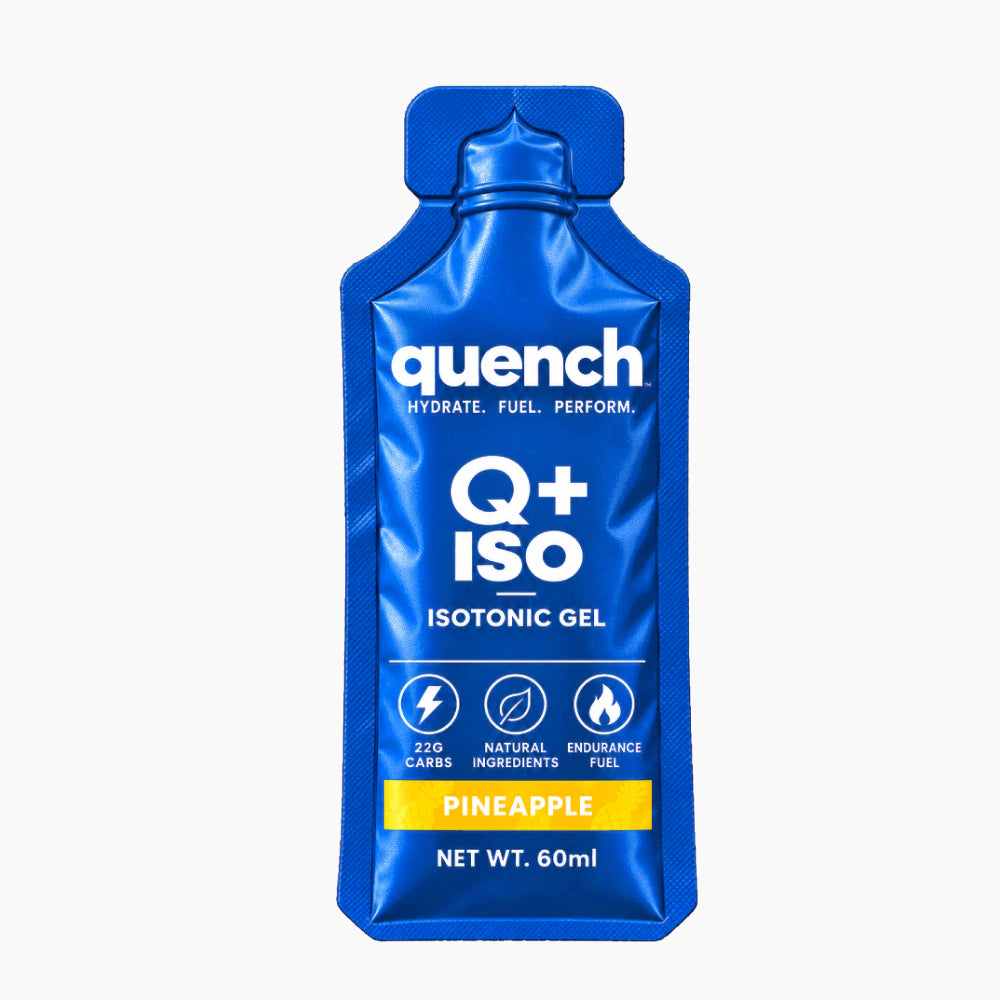
Q+ ISO: An Isotonic Energy Gel from Quench
Quench has developed Q+ ISO isotonic gel as part of its sports nutrition range.
Q+ ISO is a 60 ml pineapple-flavoured isotonic energy gel that is caffeine-free.
It offers athletes a convenient option when planning their carbohydrate fuelling during exercise.
As with any sports nutrition product, check the packaging for the nutritional information and serving instructions before building it into your training plan.
The key is to understand how much carbohydrate you need per hour and how the product fits into your overall fuelling strategy.
Is an Isotonic Energy Gel Worth Using?
An isotonic energy gel can be a useful option for runners, cyclists and triathletes who want a convenient way to consume carbohydrates during exercise without needing additional water to take the gel.
Its biggest advantage is convenience.
However, it is not automatically more effective than a traditional energy gel, and it does not remove the need to manage hydration.
Your overall carbohydrate requirements, product tolerance and training duration should guide your decision.
For shorter sessions, you may not need an energy gel at all. For longer endurance sessions, choosing the right product and practising your fuelling strategy can make it easier to meet your carbohydrate targets.
The best energy gel is ultimately the one that fits your training, your nutritional requirements and your stomach.
Frequently Asked Questions
1. What is the difference between an isotonic and an energy gel?
An isotonic energy gel is formulated to be consumed without additional water. Traditional energy gels are generally more concentrated and are usually taken with water to help with digestion and carbohydrate delivery.
Both provide carbohydrates that can help fuel endurance exercise.
2. Do isotonic energy gels hydrate you?
Not completely. Although isotonic gels contain fluid, they should not replace your normal hydration strategy.
You still need to drink water according to your exercise duration, sweat losses and environmental conditions.
3. Do you need water with an isotonic energy gel?
No. Isotonic energy gels are designed to be consumed without additional water. However, drinking water during prolonged exercise remains important.
4. How many isotonic energy gels should I take during a marathon?
This depends on the carbohydrate content of each gel and your hourly carbohydrate target.
For longer endurance events, carbohydrate intake may range from 30–60 g per hour to higher targets approaching 90 g per hour.
Calculate your requirements before the race and practise your fuelling strategy during training.
5. Are isotonic energy gels easier on the stomach?
Not necessarily. They are designed to be consumed without additional water, but this does not guarantee better digestive comfort.
Individual tolerance, carbohydrate intake, ingredients and exercise intensity all influence gastrointestinal comfort.
6. Can I use an isotonic energy gel for cycling?
Yes. Isotonic energy gels can be used during cycling, running and other endurance activities.
They offer a convenient carbohydrate source when you need fuel during exercise.
7. Are isotonic energy gels suitable for beginners?
Yes, provided the athlete has a reason to consume additional carbohydrates during exercise.
Beginners should first consider their session duration and intensity. Most shorter workouts do not require energy gels.
8. Do isotonic energy gels contain caffeine?
Some energy gels contain caffeine, while others do not.
Always check the product label. QUENCH Q+ ISO is caffeine-free.
References
This article uses information from recognised sports nutrition authorities and published research.
- Australian Institute of Sport (AIS) – Sports Gels. Guidance on sports gel composition, carbohydrate intake, isotonic gels, hydration and gastrointestinal tolerance. Read the research and guidance.
- Australian Institute of Sport (AIS) – What Does It Look Like? Explains the differences between conventional and isotonic energy gels, including water requirements and carbohydrate content. Read the guidance.
- Australian Institute of Sport (AIS) – Sports Drinks. Information on carbohydrate concentration, fluid delivery, electrolytes and hydration during exercise. Read the guidance.
-
Suna, G. and Türkay, İ.K. (2020). Acute effects of carbohydrate gel and isotonic usage on power, heart rate and glucose levels in elite cyclists. Progress in Nutrition, 22(1-S), 44–49. Read the published study.
Note: This study compared carbohydrate gel with an isotonic sports drink, not two different types of energy gel.

Quench Q+ Daily
Everyday hydration, rethought. Q+ Daily combines essential electrolytes with 150 mg of L-Theanine and B vitamins in one convenient, zero-sugar sachet. M...


Keep Learning
Explore all articles
Energy Gels Without Caffeine: A Runner's Guide
Discover how energy gels without caffeine help fuel your runs and endurance training. Learn how they work, how many carbohydrates yo...

Carbohydrate Intake for Endurance Athletes: How Much Do You Need?
Learn how much carbohydrate endurance athletes need to fuel running, cycling and triathlon. Discover daily carbohydrate targets, rec...

What Are Electrolytes? Understanding Their Role in Hydration and Exercise
What are electrolytes, and why does your body need them? Learn how sodium, potassium, magnesium and other minerals support hydration...

Hydration Before a Workout: How Much Water Should You Drink?
Learn how to hydrate before a workout, including how much water to drink, when to start and whether electrolytes are necessary. Get ...

Please share your name and email so our team can follow up if you're no longer online.